DIY acoustic slat wall: estimate NRC before you cut
A wood slat wall only absorbs sound when there are open gaps in front of a porous layer — PET felt or mineral wool — ideally with an air gap behind: built that way it reaches roughly NRC 0.4–0.85 depending on open area, absorber and air gap, while the same slats on a solid board reflect most sound. This guide shows what moves that number — open area, slat spacing, a perforated back panel, absorber thickness and a 20–40 mm cavity — and how to estimate the NRC of your own design before you cut.
What makes a slat wall acoustic?
A plain slat wall on a solid backing looks great but reflects most sound. It becomes acoustic when sound energy can pass between and behind the slats to reach an absorptive layer — typically acoustic felt (PET) or mineral wool. The slats diffuse and scatter high frequencies, while the porous backing and the air gap absorb mid and low frequencies. Together they reduce echo and make a room sound calmer.
The most effective acoustic slat panels combine three things: gaps between the slats, a porous absorber behind, and often a perforated back panel that increases the open area through which sound can enter. This is what turns a decorative panel into a genuine acoustic treatment.
NRC: the number that matters
NRC (Noise Reduction Coefficient) is the average of a material's sound absorption coefficients at 250, 500, 1000 and 2000 Hz, measured under ASTM C423 and rounded to the nearest 0.05. NRC 0 means the surface reflects almost all sound (bare concrete or glass); NRC 1.0 means it absorbs almost all of it, and lab results can slightly exceed 1.0 because of edge effects. A wood slat wall over 9–12 mm of felt or mineral wool with a 20–40 mm air gap measures roughly between 0.4 and 0.85, depending on the open area, the absorber and the cavity: published figures for bare felt alone start around 0.45 (see the lab data below). In Europe the comparable single number is αw (ISO 11654), measured to ISO 354.
NRC is driven mostly by the open area (how much of the surface is gap or perforation), the thickness and density of the absorber behind, and the air gap. More open area and a thicker absorber generally mean a higher NRC — up to a point. The acoustics section of the glossary keeps these terms in two lines each.
What NRC to expect: published lab numbers
Only spec sheets that name their test are worth quoting. One published series isolates exactly what this article is about — the effect of an air gap behind a felt absorber: Acoufelt's WoodBeQuiet Slats, a 12 mm polyester (PET) felt panel V-cut and printed to look like timber slats, tested to ASTM C423-09a.
| Build | Air gap | NRC | αw (ISO 11654) | Source |
|---|---|---|---|---|
| 12 mm PET felt panel (Acoufelt WoodBeQuiet Slats) | None | 0.45 | 0.25 | Acoufelt spec sheet |
| Same panel | 12 mm | 0.54 | 0.35 | Acoufelt spec sheet |
| Same panel | 20 mm | 0.64 | 0.40 | Acoufelt spec sheet |
Reading those numbers
A 20 mm air gap alone moves the same felt from 0.45 to 0.64 — the cheapest acoustic upgrade there is, and the reason a slat wall goes on battens rather than straight on the plaster. The low end barely moves: on the same sheet the felt absorbs 0.02–0.16 of the sound at 250 Hz against 0.89–1.00 at 2000 Hz, which is why a slat wall tames voices and clatter long before it touches bass.
ASTM C423 rounds NRC to the nearest 0.05, yet this sheet prints 0.54 and 0.64: quote a manufacturer's figure exactly as published, and read the per-frequency coefficients behind it rather than the single number. Wood slats in front of the felt change these figures — how much of the face is open decides how much sound reaches the absorber — so ask any supplier for the test report of the exact build, slats included.
Open area, slat spacing and perforation
Open area is the percentage of the panel that is gap or hole. Wider gaps between slats and a perforated back panel both raise the open area and let more sound reach the absorber. But there is a trade-off: too much open area weakens the look and the panel, and beyond roughly 20-30 percent open area the acoustic gains flatten out while the visual rhythm suffers.
A smart approach is to keep an attractive slat spacing on the visible face and add perforations to the hidden back panel to boost open area without changing the look. A parametric tool can fill the back panel with a grid or staggered perforation pattern automatically, avoiding the mortises, and show you the resulting open-area ratio and an NRC estimate live as you adjust hole size and spacing.
Slat depth, backing and the air gap
Deeper slats and a larger air gap behind the panel improve low-frequency absorption, which is where most rooms struggle. A 20-40 mm air cavity plus a 9-12 mm felt or mineral-wool layer is a common, effective build. The denser and thicker the absorber, the better the low-mid performance.
For the visible slats, wood choice is aesthetic rather than acoustic — oak, walnut, MDF or veneered board all work. The acoustics come from what is behind and between the slats, not the slats themselves.
How the studio estimates NRC
Parametric Wall Studio computes the open area of the perforated back panel as π × (hole Ø ÷ 2)² ÷ pitch² and maps it to an indicative NRC, assuming an absorber behind the panel: under 5% open area ≈ 0.30; 5–10% ≈ 0.55; 10–16% ≈ 0.70; 16% and above ≈ 0.80. It is an estimate for comparing designs, not a lab measurement.
The table below is computed with that exact formula. Note the default — 10 mm holes at a 40 mm pitch — sits just under 5%: tightening the pitch to 32 mm moves the same holes into the 0.55 band. The estimate is the same for grid and staggered patterns, and it does not count the gaps between slats or the air gap, which the lab numbers above show matter just as much.
| Hole Ø | Pitch | Open area | NRC estimate |
|---|---|---|---|
| 6 mm | 40 mm | 1.8% | ≈ 0.30 |
| 10 mm (studio default) | 40 mm | 4.9% | ≈ 0.30 |
| 10 mm | 32 mm | 7.7% | ≈ 0.55 |
| 12 mm | 32 mm | 11.0% | ≈ 0.70 |
| 16 mm | 32 mm | 19.6% | ≈ 0.80 |
Design a perforated acoustic panel with a live NRC estimate
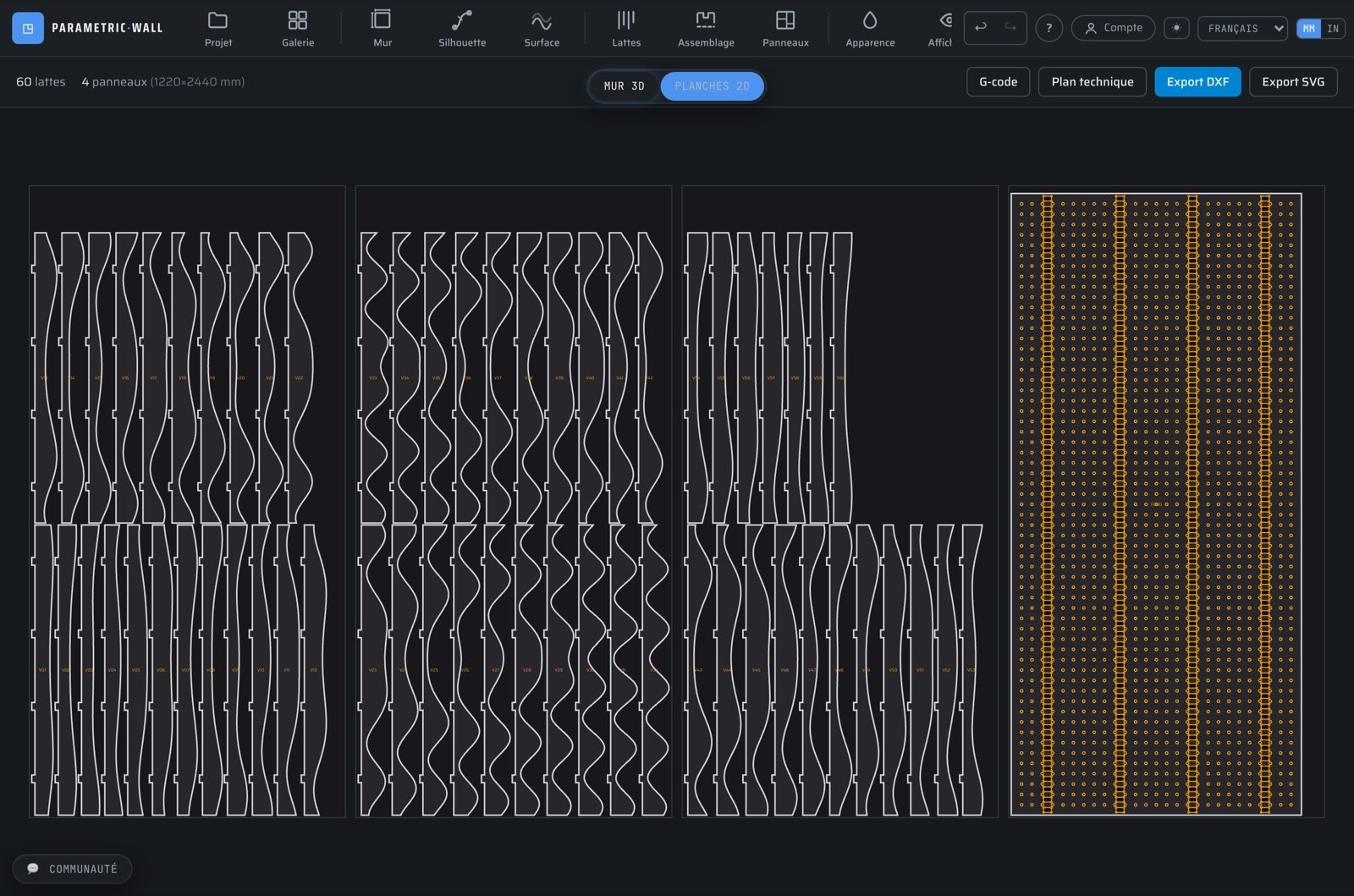
Parametric Wall Studio includes an acoustic mode: enable the perforated back panel, choose the hole diameter and pitch and a grid or staggered pattern, and the panel fills with perforations that automatically dodge every mortise. The open-area ratio and an indicative NRC estimate update as you drag the sliders, so you can tune the acoustics before you cut.
The perforated back panel needs tenon-and-mortise assembly, because it is the mortised back board that gets drilled — the joinery step of the design-to-cut guide shows where the setting lives. The perforations flow into every export — the 2D nesting view, DXF and SVG, the technical plan and the G-code — so thousands of holes are machined in the right order. You design the look and the acoustics together, in one place.
Bill of materials for a 2.4 × 1.2 m acoustic slat wall
Quantities for a 2.4 × 1.2 m wall (2.88 m²) with vertical slats cut from 18 mm stock. The studio gives the exact part and sheet count for your own settings — check it before you buy.
Slats: 18 mm MDF, plywood or hardwood. At 40 mm spacing a 2400 mm wide wall takes 60 vertical slats; at 30 mm, 80. MDF is the cheapest to paint and to machine — see the MDF slat wall machining guide.
Absorber: 2.88 m² of 9–12 mm PET felt or mineral wool, cut to fill the cavity behind the slats.
Battens: enough to frame a 20–40 mm air gap — their thickness is the air gap — fixed into the studs, not into plasterboard alone.
Back panel: a 12 mm sheet (the studio's default back panel thickness) carrying the tenon mortises; switch on the perforated acoustic back panel to drill it. At the default 40 mm pitch that is well over a thousand holes on this wall, so quote the drilling as its own operation.
Fixings and finish: screws into the battens, edge sealer and primer for MDF, and wood glue if you do not use tenons. To start from a pattern rather than a blank wall, open a template such as Soundwave and switch on the acoustic back panel.
Fire rating and humidity: where not to use it
Fire: wood and MDF slats are combustible. In a home that rarely matters; in offices, shops, restaurants and escape routes, building codes often set a minimum reaction-to-fire class for wall linings — Euroclass under EN 13501-1 in Europe, a flame-spread class under ASTM E84 in the US. Check the class required before quoting, and use fire-retardant MDF or treated timber where it applies. A felt's own rating does not cover the wood in front of it: the Acoufelt sheet above lists B-s1, d0 for the felt alone.
Humidity: standard MDF swells and loses its edges in damp rooms. Keep it out of bathrooms, saunas and walls prone to condensation; use moisture-resistant MDF, as the MDF workshop guide explains, or a sealed hardwood. The PET felt itself takes up very little water — 0.20% by weight on the same spec sheet — so the slats, not the absorber, decide where the wall can go.
Installation tips for real-world performance
Mount the panel on battens to create the air gap, fill the cavity with acoustic felt or mineral wool, and treat the whole wall rather than a small patch — coverage area matters as much as the panel itself. Corners and the wall opposite your main sound source give the best return. Combining an acoustic slat wall with soft furnishings (rugs, curtains) yields the calmest room.
Quick answers
Do slat walls absorb bass? Very little. NRC averages 250 to 2000 Hz and ignores everything below, and the felt in the lab table absorbs 0.02–0.16 at 250 Hz and 0.03–0.06 at 125 Hz. A deeper air gap and a thicker absorber help the low-mids; real bass control needs dedicated bass traps.
How wide should the gaps be? The open area of the slat face is gap ÷ spacing: 18 mm slats at 24 mm spacing leave 6 mm gaps (25% open), at 30 mm spacing 12 mm gaps (40% open). Beyond roughly 20–30% the gains flatten, so choose the gap for the look. In the studio, spacing is measured centre to centre: set it to slat thickness + gap.
Is the studio's NRC a lab value? No. It compares designs from the back panel's open area. Use it to choose between options, and a manufacturer's test report before you promise a number to a client.
Read next
Tools & guides
Ready to try it?
Design a perforated acoustic panel →